
Definition of Theocracy
We might think that most ancient civilizations – from the Mediterranean to Asia and America – fall into the category of theocratic regimes. One way or the other, religion is involved in politics. The legend has it that an eagle, Zeus’s symbol, picked up and replaced the hat of Tarquinius Priscus before he became the fifth king of Rome. Caesar Augustus and all the emperors after him had taken the office of Pontifex Maximus, the chief priest of Rome (before Christianity forbade the tradition). However, if we look at the components of the term theocracy, θεος (god) and κρατος (power), we would realize that theocracy really means “a regime in which the religion holds the power of rulership”, and thus would rule out a few ancient civilizations that instead use religion as a means to power, which I would call pseudo-theocracy.
A cross-cultural analysis of late imperial sacralization between Rome and China demonstrates some of the most fundamental issues with the claim that Rome and Ancient China were under a theocracy. It also helps to portray the status of religion among the ruling class. Roman emperor Lucius Aurelius Commodus and Chinese emperor Jiajing (嘉靖 明世宗) were both notorious for their obsession with cults and were used as false evidence for proving theocratic regimes.
Deification From Narcissism
Commodus was notorious for his pretensions to being Hercules, the hero and demigod. Being the first Roman born into the emperorship, Commodus felt a sense of insecurity from not obtaining the power by himself, which led to his vanity. Originally Lucius Aelius Aurelius Commodus, he renamed his praenomen Marcus to match his father’s as a means to emphasize his legitimacy to the throne. This was taken further with his later change of name and title to Commodus Augustus Pius Felix (Pious Blessed Commodus Augustus), Dominus Noster (Our Lord), Pacator Orbis (Pacifier of the World), Invictus Romanus Hercules (Undefeated Roman Hercules), according to an altar in Dura-Europos. According to his replacement of the names of months with his name, Commodus’s title also includes Exsuperatorius (the Surpassing One) and Amazonius (a title for Apollo). Apart from changing his name to match Hercules, Commodus’s Heraculean fever also included physical and mental imitation. He would dress up as Hercules – namely carrying a lion skin and a club–, engage in gladiatorial fights in the Colosseum, and spend most of his day training and showing off his skill in javelin and archery in public. In his later years, Commodus seemed to have even succeeded Hercules’s madness (Furens) installed by Hera, making him cruel and extremely paranoid.
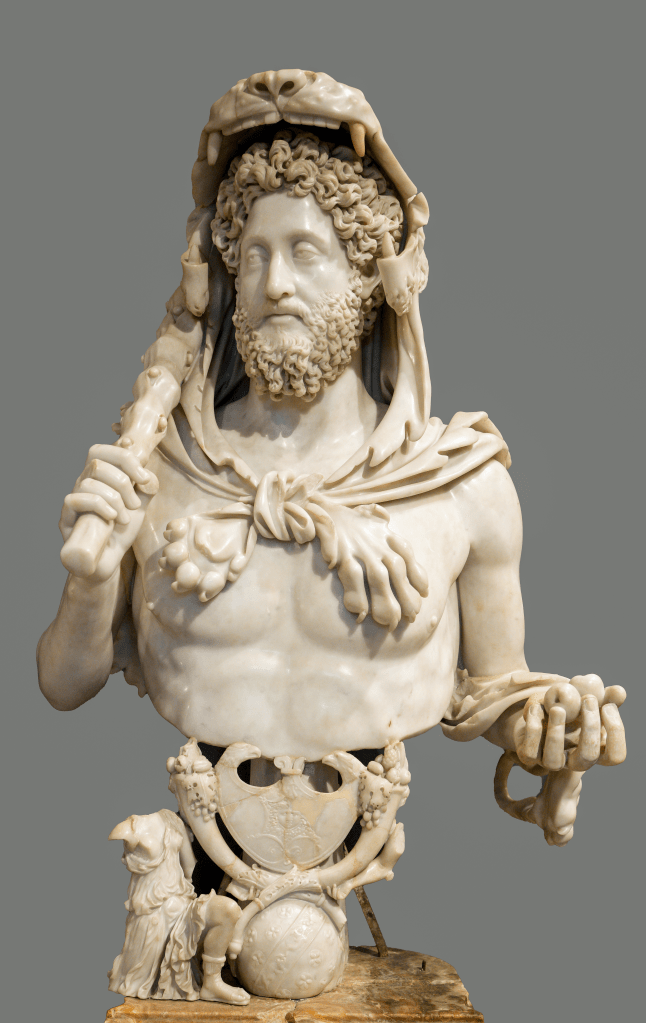
Now, the Greek traditions warned against hubris as the worst possible crime. Stories like Daedalus’s reflect the Delphic message “Know your place” as humans. So, Commodus’s actions were clearly not pious or serious about religion, but he only acted cultishly to confirm his pride and worth as the emperor of Rome. Thus, in Rome, religion served the rulership, which rules out the claim of a theocratic regime, in which the state should serve religion.
For JiaJing, his Daoist superstition derived from the seek for immortality, which could be seen as a self-betterment in Daoism, reflecting the religion’s narcissistic nature. Like Commodus, Jiajing also created titles for himself, such as:
“灵霄上清统雷元阳妙一飞玄真君”
“九天弘教普济生灵掌阴阳功过大道思仁紫极仙翁一阳真人元虚玄应开化伏魔忠孝帝君”
“天上大罗天仙紫极长生圣智昭灵统元证应玉虚总掌五雷大真人玄都境万寿帝君”
They all describe Jiajing’s deification. However, unlike Commodus’s pretension, Jiajing was serious about his self-deification, as it served only the purpose of pursuing immortality, since he knew that adopting these names would make the people lose confidence in his reign.

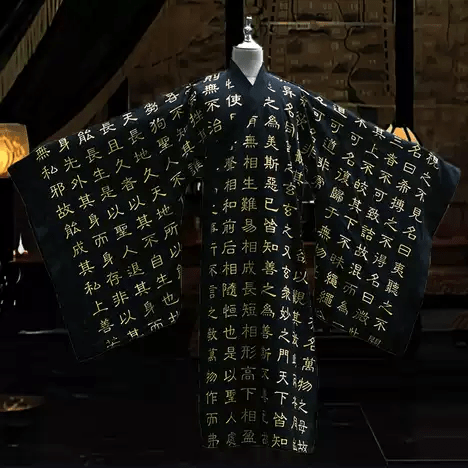
While many emperors, following the footsteps of China’s first emperor Qin Shi Huang (秦始皇), sought immortality, Jiajing’s obsession far surpassed any other ruler. Growing up under a Daoist parenthood, Jiajing’s obsession with Daoism was intensified by the Palace plot of Renyin year (壬寅宮變), a failed assassination in which sixteen palace servants hung him. Jiajing was saved by traditional Chinese medicine, and believing that he rose from death, his Daoist faith in the existence of an elixir for immortality strengthened. He then devoted all his time to his superstitions, finding the elixir or practicing religious rites. At the same time, his superstitions distanced him from his imperial duty. Later, he earned the title “Daoist Emperor” from wearing Daoist robes instead of the attire of emperors and refusing to perform his duty as an emperor.
There is no doubt that Jiajing was a pious Daoist and had wished for a theocratic regime, since he later made decisions with Daoist prophecies only. However, people criticized him for focusing on religion and thus contradicting the Confucian philosophy, which believed that a good ruler should be diligent (勤) in governance and not give attention to excessive superstitions. Later, his son dismantled Jiajing’s pseudo-theocracy after succession by purging all the Daoist bureaucrats and prophets like Yan Song (嚴嵩). The opposition he received from the bureaucrats, the people, and his family portrayed the reality that the Chinese imperial system was not a theocratic regime.
Oppositions from elites
The Roman political elites were extremely discontent with Commodus’s Herculean pretensions. In return, Commodus distrusted the senators whom his father left for him. According to Herodian’s account, “[Commodus], naked, took up arms, and fought as a gladiator, the people saw a disgraceful spectacle, a nobly born emperor of the Romans” (Herodian 1.15.7). While unpopular among the elites, Commodus did gain some support from the lower class, who appreciated their “gladiator emperor”, which distanced him from the elites to the point that the senators aroused several rebellions against him. To be accurate, gymnastics and training were seen as virtuous in Rome, as physical well-being contributes to the excellence of the soul. However, to do such things as a show in public was “disgracing his high position by degrading and disgusting exhibitions”. (Herodian 1.15.7). This reflects an important social value among the Romans: the most offensive aspect of Commodus’s actions that irritated the elites was not the blasphemy against the divinity, but the unorthodoxy of his claim to fame. The Roman elite class, orators, and historians worked as hard as possible to ruin Commodus’s fame.
ἐπεὶ δὲ καὶ γυμνὸς ἐς τὸ ἀμφιθέατρον εἰσῆλθεν ὅπλα τε ἀναλαβὼν ἐμονομάχει, τότε σκυθρωπὸν εἶδεν ὁ δῆμος θέαμα, τὸν εὐγενῆ Ῥωμαίων βασιλέα, μετὰ τοσαῦτα τρόπαια πατρός τε καὶ προγόνων, οὐκ ἐπὶ βαρβάρους ὅπλα λαμβάνοντα στρατιωτικὰ ἢ Ῥωμαίων ἀρχῇ πρέποντα, καθυβρίζοντα δὲ τὸ ἀξίωμα αἰσχίστῳ καὶ μεμιασμένῳ. (Herodian 1.15.7)
Similarly, Jiajing also had a poor relationship with the elites and bureaucracy. After the assassination, he began to rely on Daoist prophetic methods to decide on national matters, which depended fully on the interpretation of the Daoist prophet. The criticisms against Jiajing are also directed toward his reputation. Hairui(海瑞), the chief Censor, had submitted memorials to Emperor Jiajing to dissuade him from practicing cultism with absurd prophecies. He lamented: “The two kings (Jiajing and his son) don’t meet – people think poorly of the father-son relationship; You distrust and humiliate the buraecrats – people think poorly of the ruler-subject bond; You delight in the Western Garden (to practice Daoism) and does not return (to the harem)—people take this as a failure in the relation between husband and wife.”
“二王不相见,人以为薄于父子。以猜疑诽谤戮辱臣下,人以为薄于君臣。乐西苑而不返,人以为薄于夫妇。”
However, Hairui’s criticism against Emperor Jiajing served a purpose opposite to that of the Roman elites: his criticisms were privately sent to the emperor, and only a few bureaucrats knew, so he intended to protect the emperor’s reputation instead of causing harm. The criticism focused more on the consequential reaction of the people than on what he thought about the emperor personally.
The two criticisms, although both directed toward the ridiculous actions of their emperors, revealed different intentions. While Roman elites tend to attack the emperor’s reputation, the Chinese bureaucrats tried to defend it. In fact, Hairui was known to have fainted from crying when he heard about Jiajing’s death despite his harsh criticisms. This difference in the ruler-subject relationship reflects a fundamental difference in the rulership. Romans culturally hated the idea of inherited rulership, in other words, a monarchy. Although the early Roman Empire tended to pass the rulership to relatives, it was never official. Commodus was the first in Rome to be officially designated as the emperor. And, just like Tarquinius Superbus, the last king of Rome, Commodus left an awful legacy. His successor, Pertinax, was not related to him in any way, reflecting the will of the Roman elites to avoid any further hereditary monarchy. Moreover, this loathing of hereditary monarchy also meant that any elites would have access to the rulership, so when an emperor is doing badly, it is natural to undermine his reputation. For the Chinese, however, the legitimacy of the rulership is based solely on the blood relationship. As we could see in Hairui’s passage, the terms “king” and “emperor” are almost interchangeable. Even in the replacement of one dynasty over another, having the symbolic recognition from the emperor of the previous dynasty was extremely important. A typical case would be Simazhao’s (司馬昭) succession to the emperorship through his murder of the ruler of the Han dynasty. For this lack of nominal succession, he was immediately rebelled against and was antagonized by all other elites and historians. Therefore, the bureaucrats in China were loyal both to the empire and the emperor himself, since the rulership would never rightfully fall into his hands.
Conclusion
In conclusion, the comparative analysis of Commodus’s Rome and Jiajing’s China effectively reveals the nuances distinguishing genuine theocracy from what can be termed pseudo-theocracy. Both rulers, driven by intense personal motivations—Commodus by vanity and insecurity, Jiajing by the obsessive pursuit of immortality—demonstrated how religion could be manipulated as a tool of power rather than the governing principle itself. Their reigns were marked not by divine commands dictating political actions, but rather by the instrumentalization of religious imagery and rites to legitimize and reinforce their personal authority.
However, it is important to recognize that Jiajing may indeed have intended to establish a genuine theocracy based on Daoist principles. His active reliance on Daoist prophecies for governance decisions and his extensive use of religious titles indicate a sincere aspiration toward a religiously governed state. Nevertheless, this attempt was effectively thwarted by the combined resistance of bureaucratic elites, family members, and broader societal structures deeply rooted in Confucian political norms.
Moreover, the distinctive reactions from elites in Rome and China further underscore the differences between these two civilizations. Roman senators vehemently opposed Commodus’s public displays precisely because they undermined traditional political and social decorum, thus weakening the emperor’s legitimacy. Conversely, Chinese bureaucrats like Hai Rui criticized Jiajing privately, aiming ultimately to preserve imperial authority and stability rather than challenge it fundamentally. This contrast highlights how rulership and legitimacy in Rome and China were deeply intertwined with their respective cultural expectations of power—Roman elites resisting inherited monarchy and Chinese officials emphasizing the sanctity of hereditary legitimacy.
Ultimately, examining the religious obsessions of Commodus and Jiajing illuminates a broader historical truth: that the mere presence of religion within political structures does not necessarily signify a theocracy. Instead, it emphasizes how rulers throughout history have strategically employed religion to serve personal ambitions, thereby creating a “pseudo-theocratic” system wherein power dictates religion, rather than religion dictating power.
 Vox Musae
Leave a comment