
In Plato’s Apology, Socrates presents the formal accusation brought by Meletus: that Socrates corrupts the youth and fails to acknowledge the gods whom the city acknowledges, but introduces new divinities—ἕτερα δαιμόνια καινά (24b). Then he began to examine Meletus’s second accusation, breaking it into two separate charges: atheism and religious heterodoxy.
In his defense, Socrates, however, addresses only the first charge directly. He denies being an atheist, arguing that he believes in the existence of the gods, since spiritual activities (δαιμόνια) must have derived from spirits, which obviously were either the gods or the children of the gods (27c,d). But he is silent on the second charge: that he does not believe in the gods recognized by the city of Athens, namely Zeus, Hera, and the Olympian pantheon.
This silence is telling. Throughout the Apology, Socrates only mentions Apollo, the god of the Delphic oracle, who set him on his philosophical mission, and the inner divine voice that prevents him from wrongdoing. In this way, he does not refer, positively or negatively, to the other Olympian gods. In the last sentence of the Apology, that is, before Socrates is imprisoned, he calls upon “the god” (ὁ θεός) in the singular and definite article, which was uncommon in Homeric or other Greek traditions.
“And now is the hour to depart, for me about to die, for you going to be alive: But which of us go to the better affair, it is unclear to everyone except the god.” ἀλλὰ γὰρ ἤδη ὥρα ἀπιέναι, ἐμοὶ μὲν ἀποθανουμένῳ, ὑμῖν δὲ βιωσομένοις: ὁπότεροι δὲ ἡμῶν ἔρχονται ἐπὶ ἄμεινον πρᾶγμα, ἄδηλον παντὶ πλὴν ἢ τῷ θεῷ.
Apology 42
This god is unlikely to be Zeus, since it is much more common for Greeks to simply use his name “τῷ Διί” than a general and unclear addressment like “the god”. If Socrates wants to invoke the Olympians, then it is awkward to use the singular “god” and not “gods”. Thus, while Socrates disavows atheism, his dialogue seems to point to a god different than the conventional. He believes—but not in what the city believes in.
In this blog, I will examine Socrates’s heterodoxy and arrive at the divinity that he seemed to imply from his speeches.
Rejection of Orthodox Accounts
Although Socrates does not openly deny the existence of the Olympian gods, he consistently undermines traditional Greek theology by rejecting the Epic accounts of these gods found in poets such as Homer and Hesiod and by offering alternative explanations.
In Plato’s Republic Book II, Socrates famously condemns the poets’s depictions of the gods as unjust, changeable, and morally unreliable, saying that Homer has “made a bad representation of what gods and heroes are like, just as a painter who paints something that doesn’t resemble the things whose likeness he wished to paint” (377e). He used as an example Homer’s account that Zeus has two jars full of doom (fate): one of good, one of bad. Socrates believes that gods cannot be the cause of evil, “but only of the good” (379c) and thereby rejecting Homer.
His view that good things–namely, Zeus–can only yield other good things, although agreed upon Greeks, stands in direct contradiction to the Homeric gods, especially Zeus, who frequently deceives others and engages in adulteries. Socrates thus uses evidence like this to reject the Odyssey, the Iliad, and other Homeric poetry, which are the core of Greek mythology.
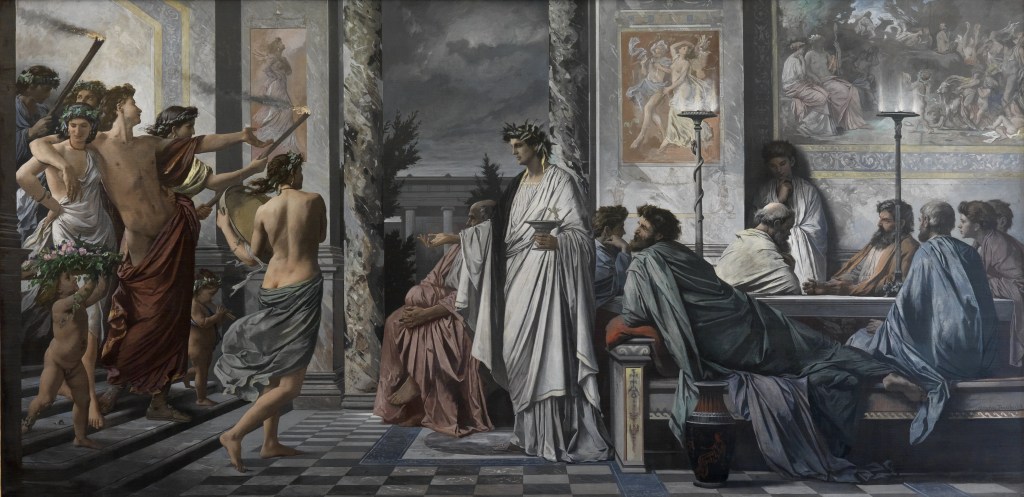
Similarly, in Plato’s Symposium, Socrates—in response to Phaedrus’s speech—contradicts Hesiod’s account of Love (Ἔρως) as a god. Instead, he argues that Eros must be a daimon (δαίμων), a spirit between men and gods. Since Love always desires beauty and goodness, he argued, it must not be beautiful and good, since one can only desire something that he lacks or might lose in the future. The gods, in contrast, are now and always beautiful and good, so they do not desire beauty or goodness, and Love must not be a god, but a daimon.
“Love is in between mortal and immortal (gods)”
Symposium 202d
Following this profoundly unorthodox claim, Socrates then presents an alternative myth to explain what Love is, claiming that Love is the offspring of Poros (personification of resourcefulness) and Penia (personification of Poverty and Need). This story has only been found in Plato’s Symposium, and hence is likely to be made up.
He is ever poor, and far from tender or beautiful as most suppose him; rather is he hard and parched, shoeless and homeless…he ever dwells with want. But he takes after his father in scheming for all that is beautiful and good; for he is brave…throughout life ensuing the truth
Symposium 203c,d
Taken together, these examples reveal Socrates’s consistent pattern: he challenges Homer and Hesiod, the bedrocks of Greek mythology, and redefines the divine. Though he avoids direct blasphemy, either by faith or societal pressure, Socrates’s theology is clearly at odds with the Athenian religion, as accurately accused of heterodoxy by Meletus.
Theory of Reincarnation
In addition to rejecting the traditional portrayals of the gods, Socrates frequently portray an afterlife at odds with the Greek religion. Although there are doubts on whether Socrates genuinely believed in it, he consistently affirms a doctrine of reincarnation. He teaches that the soul is immortal, is judged, and is re-born into new bodies, human or animal, based on its moral conduct.
Plato gives the most detailed account of this belief at the end of the Republic, in the Myth of Er . Here, Socrates tells the story of a soldier who, after died in battle, visits the afterlife, and returns to life to report what he saw. Souls are judged, then rewarded or punished, and eventually reincarnate—return to life. They choose new lives based on the moral quality of their previous existence, becoming kings or animals.
The same is reflected in Meno, in which Socrates introduces the theory that learning is just a recollection (ἀνάμνησις) previously-known knowledge, suggesting that soul is immortal and has lived many lives:
“The soul, since it is immortal and has been born many times, and has seen all things here and in the underworld, has learned everything. So it is no wonder that it can recollect what it once knew about virtue and other things.”
Meno 81c
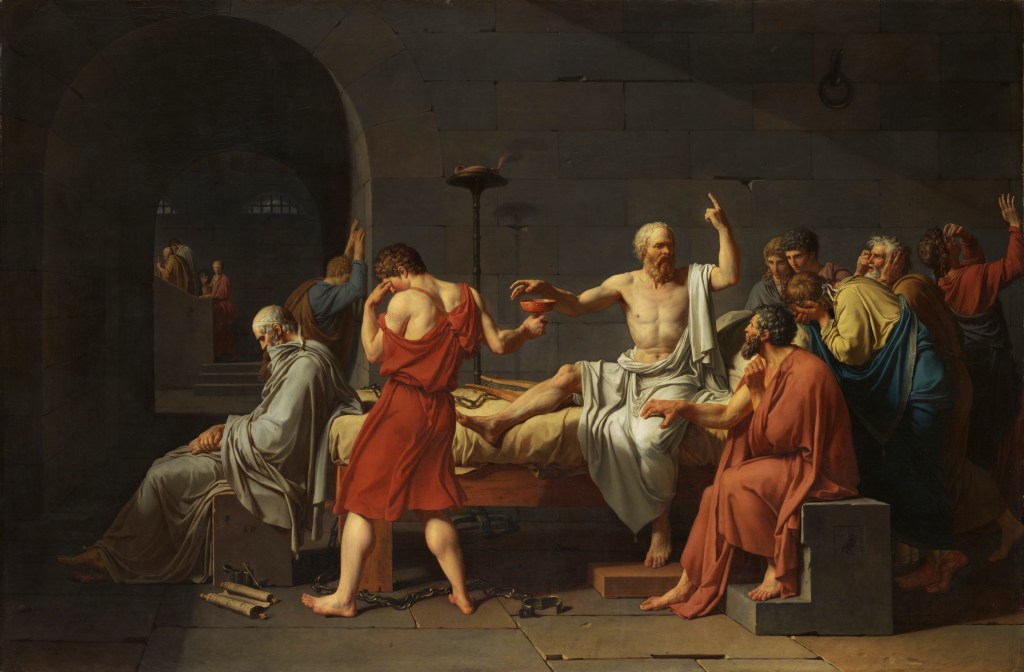
Finally, in Phaedo (70c–72e; 80d–84b), which recounts Socrates’s last conversation before death, he describes the soul’s judgment after death and its reincarnation into other beings. The soul’s next life depends on the purity or impurity it acquired through the choices it made. The philosophers who have good souls may enter in communion with the gods, while the corrupted will turn into animals:
“And those who have chosen injustice and tyranny and robbery pass into the bodies of wolves and hawks and kites. Where else can we imagine that they go?”
Phaedo 82a
This belief of reincarnation clearly contracted the portray of afterlife in the Odyssey, in which souls are kept forever after death. The heroes, according to Homer, would dwell in the Elysian Fields and the rest would suffer in Hades forever, but neither would reincarnate.
What then does Socrates believe in?
The simple response to this question would be: “Socrates believes in Apollo and his personal daimon”.
Nonetheless, Socrates clearly doesn’t believe in the entirety of the Greek traditional account of Apollo, who is said to have changed into a dolphin in Greek myths. According to a Homeric Hymn found in Delphi, Apollo takes the form of a dolphin and redirects a Cretan ship toward Delphi, where the crews dedicated a temple to him. Socrates cannot approve of this. In his Republic, he asserts that gods cannot change due to their perfection in form. Anything that changes from perfection is clearly imperfect and thus worse. Gods, Socrates continues, wouldn’t become deficient in either beauty or excellence.
“‘It is impossible then,’ said I, ‘even for a god to wish to alter himself, but, as it appears, each of them being the fairest and best possible abides for ever simply in his own form.’”
Republic 2.381c
Based on this text, we can then arrive at a few qualities that Socrates’s image of a god possesses, that is, perfection and immutability.
Then, in the Apology, where Socrates tries to understand the Delphic oracle that he is the wisest of men, he interprets it as a message that devine wisdom is far superior than human wisdom. Therefore, Socrates believes that the gods possess immeasurable wisdom.
“This one of you, O human beings, is wisest, who, like Socrates, recognizes that he is in truth of no account in respect to wisdom.”
Apology 23b
In the end, the gods or daimon whom Socrates believes in sends him a voice in his mind that stops him whenever he is about to do something unjust or speak untruthfully. Socrates uses it as a devine sign to show that his speech in the Apology is right and just.
Something, a voice from the daimon and the divinity… which, whenever it happens, it always turn me away from the thing which I’m about to do, but it never encourages. μοι θεῖόν τι καὶ δαιμόνιον γίγνεται φωνή… ἣ ὅταν γένηται, ἀεὶ ἀποτρέπει με τοῦτο ὃ ἂν μέλλω πράττειν, προτρέπει δὲ οὔποτε.
Apology 31c,d
Therefore, a quality that Socrates’s gods possess is justice. The divinities in which Socrates believes are far more morally and metaphysically exacting. They are unchanging, immeasurably wise, and fundamentally just. Thus is Socrates’s heterodoxy—a quest for morality and wisdom that leads him to reject the orthodox theology of the multitude.
 Vox Musae
Leave a comment