
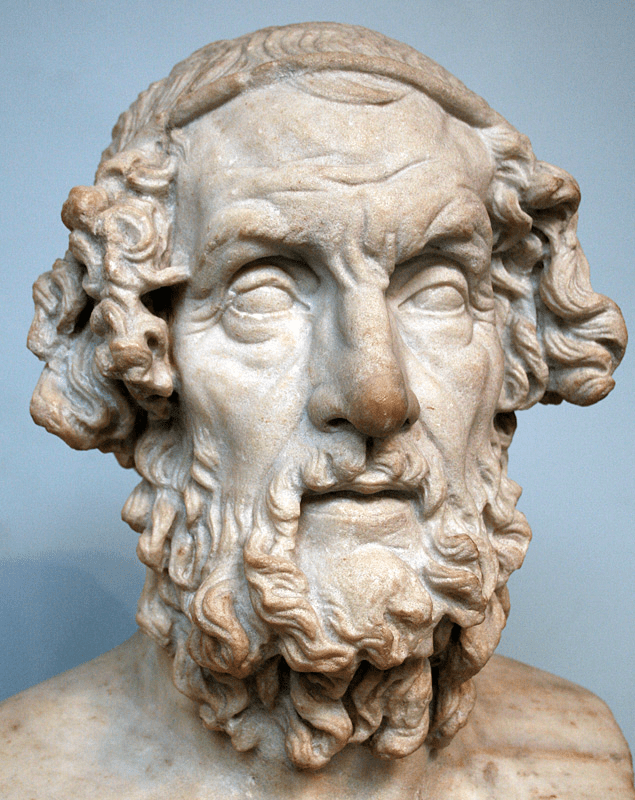
Homer is doubtlessly the most influencial poet in the Classical world. Poets like Virgil saw him as the peak of all poetry; Philosophers like Plato published his views on Homer; Scholars like Strabo called him the father of geography. However, we know very little about Homer himself other than a bust we found and the fact that he is blind and possibily illiterate.
The question whether Homer “exists” is first risen by some ancient greek scholars, known as Chorizontes (Χωρίζοντες) or the “seperators”. Analizing Homer’s Odyssey and Iliad, scholars found a presence of dialects across different time periods and geographical location. This inconsistence of dialect could point to a possible split of authorship. They, however, remained marginalized among ancient scholars, and the debate did not last after their generation as later scholars returned to the belief that Homer is one person.
Among modern scholars, however, the doubts on his existence is much wide spread. Famously, scholars like Milman Parry and Albert Lord came up with the theory that the Odyssey and Iliad was a product of oral-formulaic composition. They saw the repeated phrases in his works not as literary technics, but “Homeric formulas”, a means to make the meters work. For example, when Homer needs to fill in the last 2.5 feets for a line, Achilles was often describes as “swift footed Achilles”: τοῖσι δ᾽ ἀνιστάμενος μετέφη πόδας ὠκὺς Ἀχιλλεύς. When he needs to only fill in 2 feets, he is described as “devine”: τὸν δ᾽ ἠμείβετ᾽ ἔπειτα ποδάρκης δῖος Ἀχιλλεύς. They believed that the illiterate rhapsodes didn’t write their works down and thus needs these phrases as formulas to keep the song running. The formulas really served the purpose of filler words instead of something that bore meanings. The entire claim is based on a discovery of the Serbian oral-traditioned poets that somewhat resembled Homer.
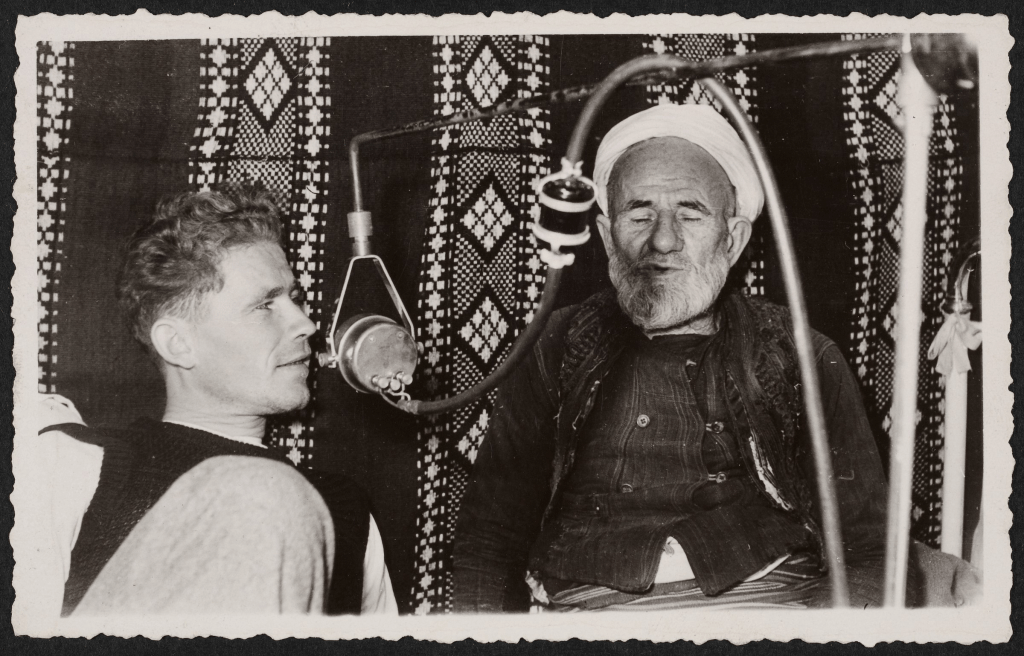
Parry and Serbian Oral Literature Performer
Although the claim offers an interesting speculation to the compositions to the Epics, I believe that too much assumptions were made in the process of arriving at this theory. First, the inconsistence of dialect cannot prove different authorship. Our discovery of Homer’s epics were fragmented peices of works. It is totally possible that later rhapsodes add their own flavors in reciting the epics after one single poet named Homer composed it. We have no evidence to claim that different rhapsodes cannot take some liberties in reciting Homer. In fact, from Plato’s Ἰων one can rightfully claim that there is some kind of difference among rhapsodizing Homer, since there needs to be some variation in style or performance for people to compete for the champion. Afterall, it is devine inspiration (μοιρα μουσας), not skill (τεχνη), that drives each rhapsode to recite Homer, so each versions should be different. Second, scholars seem to assume that we have a more complete knowledge about ancient greece than the ancient greeks themselves. I often hear Classicists saying that, “Just because this scripture is lost doesn’t mean it isn’t famous or important”, blaming medieval scholars for losing the texts. In this case, it would be ridiculous to assume that the greeks have less evidence than us to examine the existence of Homer. Imagine scholars claim that Christ doesn’t exist based on some detailed textual differences between the four books of the Gospel. It is important to understand that we, even with the help of archeology and modern science, do not have nearly as much information as the people living in the ancient world. We cannot make claims based on the limited resources we have without considering the prevalent belief of Homer’s existence in the ancient world.
“A group of words which is regularly employed under the same metrical conditions to express a given idea“
— Milman Parry
After the doubt on Homer’s existence become prevalent, more radical theories were made. For one, in his work The Authoress of the Odyssey, Samuel Butler speculated that the author of the Odyssey is a woman, due to the fact that Odysseus’s journey was often guided by strong woman figures like Athena, Circe, and Calypso. Somehow, Butler believed that a work that praises the role of women could only be composed by female authors. His work was later popularized for political purposes and quoted by activist propogandas, which deviated the study of Classics further from the investigation of history to a tool for politics.
I have a mixed attitude regarding these new speculations. On the one hand, these new theories keeps Classics alive and active: Scholars, like their Alexandrian predecessors, examine and debate about Homer passionately, providing scholarly insights that might help readers to appreciate it more. On the other hand, from some speculations, I sense a trend that might lead to an unserious attitude toward history. Scholars need to be aware of a danger of taking too much liberty in literary interpretation to the point that theirs claim reflect more of a willful fantacy than true history.
This passage doesn’t aim to discourage readers from looking into or agreeing with recent scholars’s claims about the classical world. But, instead, I encourage you to think critically about their claims and read their process of discovery to decide for yourself whether to believe it or not.


Leave a comment